TV SCHEDULE
SCHOOLS
SHOWS
5 in 15
A Conversation With...
All 22
Around The Mountain
Coach's Cut
Full Court Press
It's A Numbers Game
Legends
Mountain Sports Report
Mountain West Football Saturday
Pre/Half/Post Show
Rivalries
Season Pass: CSU Men's Basketball
Season Pass: UNLV Women's Basketball
Stories of the Mountain West
Women's Basketball Weekly
VIDEO
BLOGS
CONTESTS
NETWORK
Anchors
Employment/Internships
F.A.Q.
How To Get The Mtn.
Media Affiliates
Network News
Sales/Advertising
Social Network
Talent
Video Request
What Are They Saying?
STORE

FIND US ON |
 |
 |
 |
Holden: Watts' New Tower
 Facebook
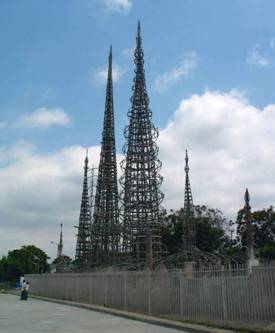
Image Credit: BenFrantzDale
February 4, 2012
Stare up at Watts Towers and you'll find a mast of hope in a city that has often needed it. Stare up at James Boyd and you might see the same thing.
In 1959, the city of Los Angeles tried to tear down the former of the two.
Standing 99 feet tall, made entirely of scrap metal, constructed primarily with the use of window-washing equipment and decorated by pieces of porcelain, cracked tile and soda bottles, the city deemed Watts Towers a safety hazard and ordered it razed.
Onlookers watched as cranes moved in to annihilate the product of 34 years of labor by immigrant construction worker Simon Rodia. They cheered as the machinery malfunctioned, unable to destroy or even alter the structure.
It was a small miracle for Watts. It was followed by a lions-share of losses.
The 1965 Watts Riots – the result of racial tensions flaring over a traffic stop – caused 34 deaths, over 1,000 injuries, nearly 3,500 arrests and more than $40 million in property damage. From 1989 to 2005, police reported more than 500 homicides in Watts as gang activity increased.
Watts Towers became an afterthought.
"Nothing good ever comes out of Watts," Boyd said. "That's what most people still think."
Boyd would love to change their minds.
Standing 6-foot-5, 243 pounds, raised by a single mother, mentored by two former gang members, taken in by a church and revived by a community college coach, Boyd is just as patchwork as his city's most notable landmark.
And he's proving just as indestructible.
Over the past two years, Boyd was forced to leave his dream school. He suffered through a knee injury and academic ineligibility. He spent a year out of football.
Not only is he still standing, he signed a national letter of intent to play quarterback at UNLV on Feb. 1.
There is one big difference between Boyd and Watts Towers, though. For at least a while, a few Los Angeles authorities believed him to be a work of art.
"Even in this class," read a local newspaper headline announcing USC's 2009 recruiting class, "Boyd manages to stand out."
"Talk about a dynamic football player and athlete," then-Trojan head coach Pete Carroll said of Boyd. "He was an MVP in his league as a quarterback, caught passes and ran the ball, played wide receiver and tight end, was an extraordinarily effective defensive end and rusher, and is leading his basketball league in scoring and rebounding.
"We've never had a guy who could do that much coming to play defensive end here."
Yes, Boyd could do it all. That's exactly what the Trojans asked of him.
After signing as a defensive end, Boyd became a tight end before the start of his first season. He switched back to defensive end the following spring only to finish offseason workouts at quarterback.
Somewhere in the midst of all that, he twice attempted to walk on the basketball team.
Does your head hurt yet? Boyd's did. His grades reflected it.
Academically ineligible and falling out of favor with new head coach, Lane Kiffin, Boyd returned to Watts half expecting to disappear where so many others had before him.
The cranes moved in. Watts beat them back yet again.
"I couldn't believe it," Boyd said. "Even after I left SC, there were kids in the community who still wanted to see how I was doing – people telling me Watts was still proud of me."
Two former gang members – Beezy and Twitter, as Boyd knows them – pushed Boyd back into the gym and onto the field with as much zeal as anyone.
But Boyd was hardly the first. Using pseudonyms for their own safety, Beezy and Twitter are active in the Watts community trying to get others youths like Boyd headed in the right direction.
"That's what a lot of people don't understand," Boyd said. "A lot of gang bangers are trying to get kids off the streets, not trying to pull them into gangs."
Instead, Boyd found himself joining Glory Christian Fellowship International. Pastor Alton Trimble not only noticed, but at times was overcome with Boyd's devotion.
"James has a tremendous understanding about dealing with the opening and closing of doors," Trimble said. "He was with us every Sunday, and I prayed with him through many milestones. Where he's headed now, it's a testament to his character."
Where Boyd is headed now may not have been possible without the vote of confidence from Marguet Miller and his coaching staff at West Los Angeles Community College.
Despite the fact that Boyd’s grades were improving when he left USC, Miller knew there was a chance that his paperwork wouldn't clear and he'd have to sit out another year. That's exactly what happened.
On game days, Boyd occupied the bench. During the week, he was relegated to the scout team. West LA’s defense, which ended up being the top-ranked unit in the state in 2011, was the beneficiary.
"Every day in practice, our defense up against the best scout team quarterback I've ever seen," Miller said. "James was out there directing the offense, having fun, encouraging guys and trying to embarrass our defense.”
It was on the way to one of those practices that Boyd ran into UNLV assistant Mike Gray. Seeing that Gray looked lost, Boyd offered to help. On the walk to Miller's office, Boyd noticed the UNLV polo and asked Gray who he was there to see.
"A guy named James Boyd," Gray said.
A smile, an explanation – “quarterback or nothing" – a workout and a campus visit later, Boyd had himself a scholarship offer.
The words to describe his journey to Las Vegas were hard for Boyd to find. That's just fine with his new coach.
"Talk is cheap," UNLV head coach Bobby Hauck said. "Actions speak loudly. James has done a lot to get here. We're eager to see what he can do for us."
The onlookers in Watts are eager to watch.
“James has a lot of people behind him,” Trimble said. “He’s nothing short of a modern-day miracle.”
| Add your comments below | |
| You need to log in to post comments. | |
| Username: | password: |


NOW PLAYING
| 11:30 am | Mountain Sports Report pres. by Dodge MW News |
COMING UP NEXT
| 12:00 pm | Coach's Cut: Classic Men's Basketball Colorado State at UNLV (1/19/11) |
| 2:00 pm | Coach's Cut: Classic Women's Basketball Oklahoma at TCU (1/2/11) |
| 4:00 pm | Game Time with UNLV Basketball |
| 4:30 pm | Ram Basketball Report |
| 5:00 pm | Ram Sports Magazine |
| 5:30 pm | Mountain Sports Report pres. by Dodge MW News |
ALL TIMES MOUNTAIN
| Key in your zip code and find out which service providers in your area carry The Mtn. | |
| Channel: | |
The Mtn. is available nationwide on DIRECTV channel 616. Check with DIRECTV to find out if your programming package includes The Mtn.
PURCHASE DVDs FROM THE MTN.
We are currently offering game DVDs, special programs and box sets from some of our most popular shows. We will be adding more products to the store as they become available.
VISIT THE STORE
We are currently offering game DVDs, special programs and box sets from some of our most popular shows. We will be adding more products to the store as they become available.
VISIT THE STORE

